Norco Composite Decks
Big backyards here invite a deck sized for a long table, a grill and the whole family, and that much wood means a lot of sanding and staining. Composite skips that chore. Ben plans the board color, the frame under it and the border around it, so a big deck stays cool enough to walk on and flat enough to look right for years.
Why Owners of Big Lots Pick Composite Boards
The first thing people tell us about a wood deck on acreage is how much of their weekend it eats. A deck that wraps the back of a ranch house can run long enough that restaining it turns into a two-day job, and boards left in full sun start to gray and check after a few summers. Composite boards are made to hold their color and surface without that cycle.
On a property where people come in from the barn or the corral, a deck also takes dirt and grit that grinds into soft wood. A composite surface sweeps and hoses off. It will not splinter under bare feet, and it does not need a sealer renewed on a schedule. It still wants a wash now and then, especially in shady corners, and that is about the whole maintenance list.
Composite behaves differently from wood, though. It is heavier, it moves with the temperature, and it leans entirely on the frame below it. Our main composite decks page goes deeper into board types and finishes. The sections below cover what changes when the deck sits on a big Norco lot.
Board Color and Afternoon Heat
Inland Empire summers are hard on any deck surface, and composite takes the heat more than people expect. The boards soak up sun, and a dark board in an open yard can get too hot for bare feet by mid-afternoon. Color is the biggest lever you have. Lighter grays, tans and weathered tones run noticeably cooler than deep browns and charcoals.
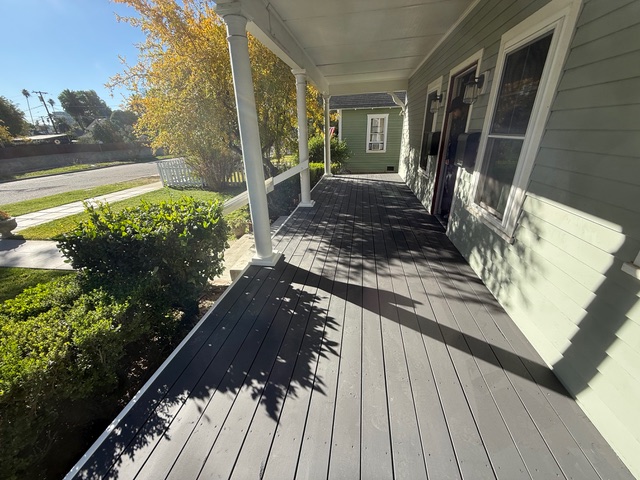
Dark boards like the ones on the porch above look sharp. On an open deck they also catch every hour of sun. So before we pick a board, we look at where the deck sits and which way it faces. A deck on the west side of the house, with nothing between it and the late sun, is where a light color matters most. One tucked under a cover or on the shaded north side gives you room to choose a darker tone.
Heat also makes composite move. The boards grow in length as they warm and shrink back as they cool, so every board maker publishes gaps for the ends of boards and the space against the house, tied to the temperature on install day. We set those gaps by the chart, never from memory, so a long run does not buckle in July or open up in January.
The Frame Underneath Does the Real Work
Composite boards carry your weight from one joist to the next, and that is all they do. They are not structural, and they flex more than wood between supports. Most composite boards call for joists set closer together than older wood decks were built, and closer still when the boards run on a diagonal. We follow the spacing in the maker’s instructions for the exact board you choose.
The frame itself is pressure-treated lumber on most of our decks, with steel framing as an option when a client wants it. Either way it has to be flat. Composite shows every high joist and every dip, so we run a string line across the tops and shim or plane the high ones before the first board goes down. Wood joists also get a joist tape on top, which keeps water from sitting in the screw holes.
A composite deck is only as straight as the joists under it.
Hidden Clips and a Picture-Frame Edge
Grooved composite boards can be fastened with hidden clips that sit in the board edges and screw down into the joist. From above you see a clean field of boards with no screw heads, and the clips hold the gap between boards even. Solid-edge boards, and the boards along the outside, get face screws in a matching color, set in a neat line so they read as part of the pattern.
A picture-frame border is a board or two laid along every outer edge, with the field boards stopping against it. It covers the cut ends, which are the least finished part of any composite board, and it gives the deck a crisp outline. A contrasting color in the border is a popular look. The border needs extra blocking in the frame, so we draw it in before a single joist is set.
Stairs get the same care. Composite treads need their stringers closer together than wood treads do, and the riser and fascia boards that cover the frame are what people see from the yard. We wrap the rim with fascia that matches the field or picks up the border color, so nobody on the lawn is looking at bare framing.
Composite Under a Pergola or Patio Cover
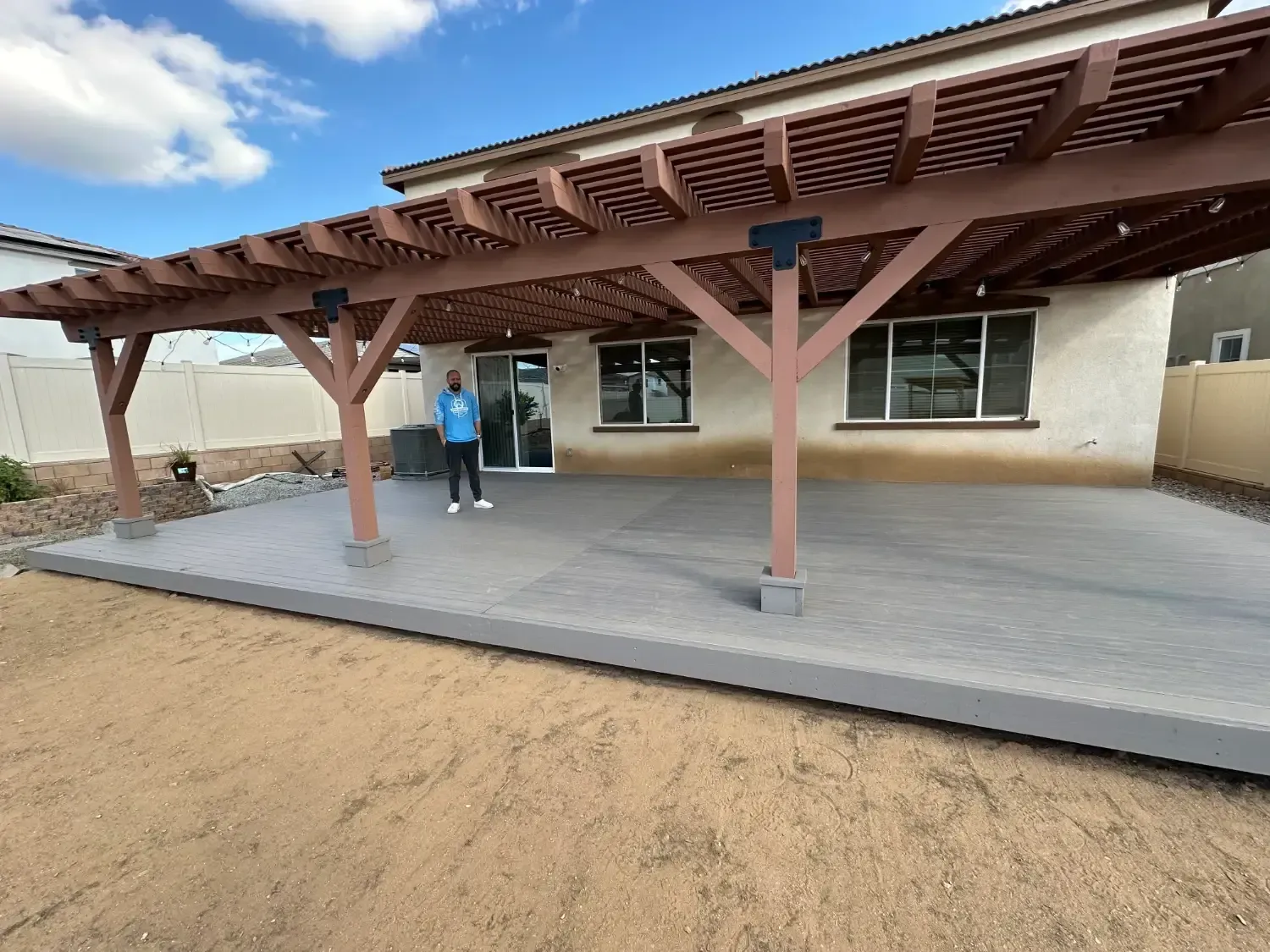
Plenty of decks on Norco properties end up with shade over them, and composite works well under an open pergola or a solid patio cover. The photo at the top of this page shows that pairing, gray boards under a stained wood pergola with knee braces at the posts. Shade keeps the surface cooler, which also opens the door to a slightly darker board.
The two get planned together. Pergola and cover posts need their own footings, and they either pass down through the deck to the ground or land on blocking built into the frame for them. Deciding that after the boards are down means cutting into a finished deck. We lay out the post locations first, frame around them, then run the boards. A cover also adds a structure to the lot, so Ben checks its footprint against the city’s setbacks and horse-keeping rules before it goes on paper.
A solid cover changes how water reaches the deck. Rain leaves the cover edge in one line, so we keep that line where it can drain and leave board gaps that let water through. Shaded composite can grow mildew where it stays damp, and a rinse each spring keeps that in check.
More Outdoor Work Around Norco
Composite deck owners often ask about these next. The full list of our work in town sits on the Norco page.
Norco Deck Repair
Sunken posts, tired joists and loose boards fixed on an existing deck, keeping whatever framing is still sound.
Norco deck repairNorco Dry Rot Repair
Soft rim boards, post bases and fascia ends cut out and replaced once we find where the water came from.
Norco rot repairNorco Deck Railings
Mesh panels, wood pickets or metal balusters at code height, with posts bolted through the rim.
Norco railingsNorco Wood Porches
Front porch framing, decking, beams and steps rebuilt to suit a ranch or craftsman house.
Norco porchesComposite Deck Questions From Norco Owners
Is composite too hot to walk on in Norco summers?
Dark composite in full afternoon sun can get uncomfortably hot. Lighter grays and tans stay noticeably cooler, and shade from a pergola or patio cover helps even more. We look at which way the deck faces and how much sun it gets before suggesting a color, so the choice fits the spot.
Can composite boards go on my old wood deck frame?
Sometimes. The frame has to be sound, flat and built with the joist spacing the new boards call for. Many older decks were framed for wood boards with wider spacing, so they need joists added. Ben probes the existing framing and footings first and tells you whether reusing it makes sense.
Do composite boards need gaps between them?
Yes. Composite grows and shrinks with temperature, mostly along its length. Each manufacturer lists the spacing needed at board ends, along the edges and next to the house, and the numbers change with the temperature during install. Our crew checks them against that chart the day the boards go down.
What is a picture-frame border on a deck?
It is a perimeter row of boards that outlines the deck, with the field boards butting into it. It covers the rough cut ends, gives a crisp edge and can be a contrasting color. Because it needs extra blocking underneath, we plan it before the joists go in.
Will composite hold up to dirt and gravel tracked in from the yard?
It handles it well. The surface does not soak up dirt the way bare wood does, so a broom and a hose clean it. Like any deck it can scratch when gravel gets ground in underfoot, so a mat at the steps and a regular sweep keep it looking good.
Can you add a pergola or patio cover over a new composite deck?
Yes, and it works best planned together. Cover posts need their own footings and blocking, which go in before the boards. Planning both at once avoids cutting into finished decking later, and it lets Ben check the whole footprint against Norco setbacks before anything is drawn.
Free Norco Composite Deck Quote
Ben can tell you on the phone whether your old frame is worth keeping.
(909) 227-4193 Or send a few photos of the yard and the deck size you have in mind, and Ben will call back to set a time. Send Us the Deck SizeDecks and Pergolas From Past Jobs
Composite and wood decks, pergolas and covers from around Riverside County.