Fascia Repair for the Edge of Your Roof
A soft fascia board usually has company: a rafter tail gone punky behind it, an eave board stained by the same water. Ben replaces what is rotted, primes every side of the new wood, and leaves a solid edge for the gutter to hang from.
What a Fascia Repair Usually Turns Up
Fascia is the board that runs along the edge of your roof, nailed across the ends of the rafters. It closes off the eave, gives the roofline its finished edge, and on most houses it is what the gutter screws into. Because it sits right where the roof sheds water, it is one of the first pieces of exterior wood to rot, usually at the corners, at the butt joints, and along the bottom edge where the paint fails first.
Pulling the old board is what tells you how big a fascia repair really is. Sometimes the rafter tails behind it are sound and the job is a new board, primed and painted. Often the water that rotted the fascia got into the tail ends too, and those have to be cut back and rebuilt before anything new goes on. On houses with exposed rafter tails, like this garage, the tails are part of the trim, so they get repaired to look like the originals. Ben has done this work around Riverside since 1990, and he shows you what he finds once the board comes off.

What Sits at the Edge of an Inland Empire Roof
The roof edge is a small assembly, and fascia lasts only as long as the pieces around it do their jobs. These are the parts we check on every fascia call.
The Fascia Board
A painted board running the length of the eave and up the rakes. We look at the corners and joints first, then the bottom edge, and push an awl in anywhere the paint has cracked or peeled. Sound wood stops the point. Rotted wood lets it sink.
Sub-Fascia and Rafter Tails
Some homes have a framing board, the sub-fascia, behind a finish board. Many older ones nail the fascia straight to the rafter ends. Either way, that hidden wood is what actually carries the gutter, and when it is soft a new face board only covers the problem.
Eave Boards and Soffit
The underside of the eave takes water once the fascia fails. On older Riverside and San Bernardino homes the eave is often plain boards or tongue-and-groove, with vent openings between the rafters. Stained or sagging eave boards get replaced in kind, and the vents stay open.
The Gutter Line
A gutter that overflows, or one set tight against the board with no way for water to get past, keeps the fascia wet. A gutter that has pulled forward and sags is usually telling you the wood behind its hangers has rotted.
Your Gutter Hangs on That Board
A gutter full of rainwater and leaves is heavy, and all of that weight hangs on screws driven through the fascia. When those screws bite into sound wood and reach the rafter tail behind, the gutter holds its slope and empties at the downspouts. When the wood is soft, the screws loosen and the gutter tips forward. Water collects in the low spot and spills over onto the same board that is already rotting. That cycle is why fascia rot speeds up once it gets going.
For the repair to hold, every hanger has to land in solid wood, with a fastener long enough to reach it. When the gutter comes down for the work, it should go back up with its slope checked so water runs to the downspouts and does not sit. If an attached patio cover hangs off the same edge, we look at how it is fastened while we are up there. Our wood patio covers page explains how a cover should be carried.
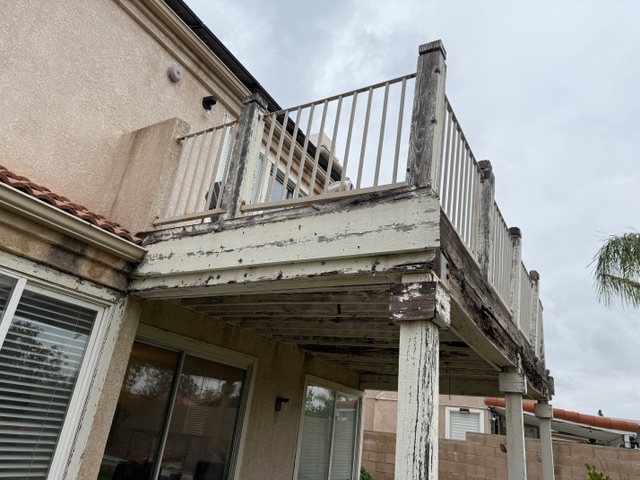
The house in this photo shows the other way fascia goes in the Inland Empire: weathered gray, paint gone, the wood checked and split along the roof and the deck edge. Once sun opens the grain like that, the next few rains finish the job.
Fitting New Fascia to an Older House
Pull and Probe
The gutter and the damaged run of fascia come down. Ben probes every rafter tail and the sub-fascia, marks what has to be cut back, and lists each piece in the quote, so you know what is being replaced and why.
Match Size and Texture
Lumber cut decades ago often runs fuller than today’s boards, and some older homes have rough-sawn fascia. A modern board butted against an old one leaves a step you can see from the street, so we size and surface the new piece to line up with what stays.
Prime All Six Sides
Face, back, both edges and both ends get primer before the board goes up. Water gets in through the back and the ends, and a board primed only on its face rots from behind. Joints are scarfed at an angle over a rafter tail so they stay closed, then caulked and painted.
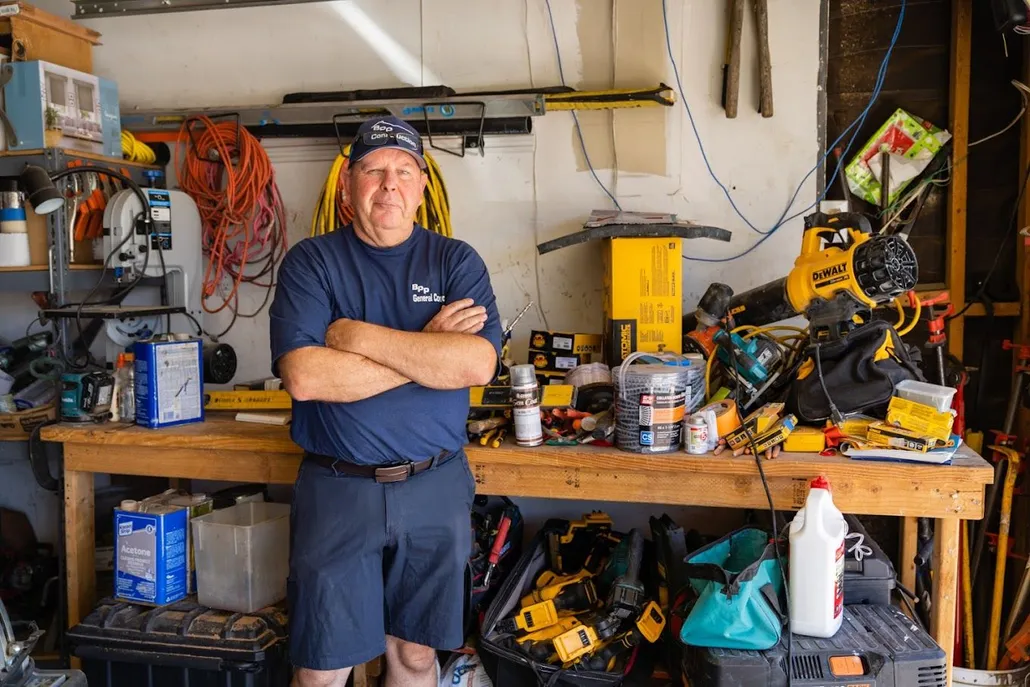
Ben owns the company and has been fixing roof edges on Riverside and San Bernardino County homes for 35 years. He would rather tell you that two corners need work than sell you the whole eave. If the entire run is soft, he says that too, and shows you the boards.
Older homes throw curveballs: a profile nobody stocks anymore, a rafter tail cut to a shape, a patch from a previous owner that has to come out. Each one gets matched to what is already on the house, profile by profile, so the repair disappears into the roofline.
Exterior Work That Meets the Roofline
Fascia work often turns up something next door to it. When rot reaches into rafters inside the wall line, it becomes structural wood replacement. Everything else we do is on our services page.
Dry Rot Repair
Decay that has spread past the eave into trim, posts or framing gets cut back to sound wood, and we track down the water behind it.
Dry rot repairWood Exterior Repair
Siding, window trim and corner boards rebuilt to match when the damage runs down the wall below the roof edge.
Exterior wood repairExterior Painting
New fascia needs paint to last, and a full repaint ties fresh wood into the rest of the house so the repair disappears.
Exterior paintingFascia and Eave Questions Under California Code
Do I need a permit to replace fascia boards in California?
Usually not for the board itself. In most Inland Empire cities, replacing fascia with the same size and type of material is treated as maintenance. That changes when the job reaches into the structure, such as rebuilding rafters, or when the fascia work is part of a reroof or an addition that already carries a permit. Rules vary from city to city, and your city’s building department has the final word. Ben checks before the work starts and pulls a permit if one is needed.
Are rotted rafter tails a structural repair?
Rafters carry the roof, and the tail is the end of the rafter that runs past the wall to form the eave. Repairing a few rotted tail ends outside the wall line is often handled as a repair, while replacing rafters back inside the wall is structural work that most building departments want permitted and inspected. Where your job falls is the building department’s call. Either way, the repaired tail has to be fastened to sound rafter wood so it carries the fascia and gutter the way the original did.
What does the code say about eave vents when eave boards are replaced?
Section R806 of the California Residential Code requires attic ventilation, and on many homes the intake air comes in through vents in the eave or in the blocking between rafter tails. When we replace eave boards or blocking, those openings stay open and screened, because covering them cuts the attic’s airflow and traps heat and moisture up there. In a fire hazard severity zone the vents themselves also fall under the fire zone rules.
Does new fascia need a drip edge over it?
On an asphalt shingle roof, the residential code calls for a metal drip edge along the eaves and rakes, and it matters to the fascia more than to the shingles. It kicks water out past the board instead of letting it run down the face and in behind the gutter. Plenty of older roofs never had one, or have one bent flat by years of ladders. When we replace fascia, the new board goes in under the existing roof edge, and on a shingle roof we make sure a drip edge sits over it. Tile and other roofs have their own edge details, and we work to whatever is on the house.
Can a patio cover be attached to my fascia board?
A fascia board is trim, and it was never sized to carry a roof. An attached patio cover needs a ledger or connection fastened to framing that can carry its load, and the building department reviews that connection on the permit for a new cover. We find older covers hung straight off the fascia, and that is a common reason a fascia pulls away from the house. If we find one during a fascia repair, we show you and talk through how it should be supported.
What wood should replacement fascia be?
The decay-protection rules in Section R317 mostly cover wood close to the ground or resting on concrete, so fascia up at the roofline is not usually required to be treated. What matters more is a straight, dry board primed on all six sides. We match the thickness, width and species of what is on the house, and where the trim is redwood or cedar we stay with that wood. In a fire hazard severity zone we use material that meets the zone requirements.
Eave Repair Across Riverside and San Bernardino Counties
Ben has been rebuilding roof edges on Inland Empire homes since 1990. Call him about the soft board or the sagging gutter, and he will tell you what is behind it.
(909) 227-4193 ben.bpp@gmail.com Request a Fascia QuoteBased in Riverside, CA, repairing fascia and eaves for homeowners across Riverside and San Bernardino counties, within about 35 miles of town.