Deck Repair From the Footings Up
A board that gives underfoot, a post gone dark at the bottom, a railing that moves when you lean on it. Ben gets under the deck first, finds what is actually failing, and tells you straight whether it is worth fixing.
Deck Repair Starts With an Awl and a Flashlight
Most calls we get about deck repair start with something the homeowner can feel. The soft board is real, but it is a symptom. Before Ben talks about fixing anything, he crawls under the deck with a light and an awl and probes the wood that carries the load: the posts where they meet concrete, the joist ends where they sit on the beam, the ledger where the deck ties to the house, and the footings underneath it all. Sound wood pushes back against the point. Decayed wood lets it sink in and comes out wet and stringy.
That half hour under the deck decides the whole job. A few rotted boards and one bad joist end is a repair. A ledger that has pulled away from the house, or half the posts gone soft at grade, is a different conversation, and Ben will say so plainly instead of patching something that fails again in two winters. He has been doing this in Riverside since 1990. Being upfront about which way a deck should go is how he has kept customers that long.
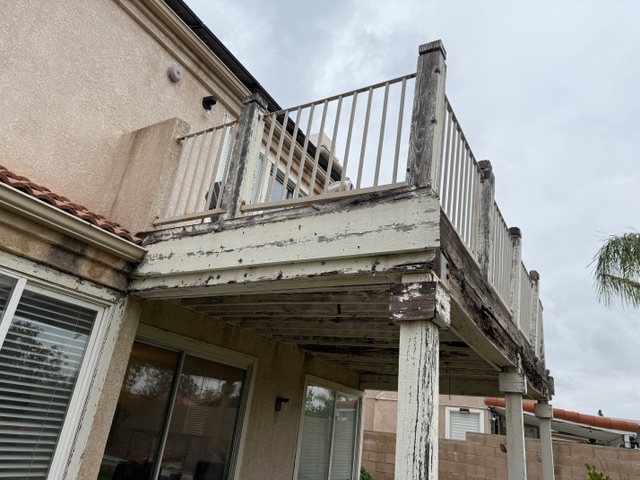
Four Places a Deck Fails First
Water is behind almost every deck repair we do. It finds the same few spots on every deck, so those are the spots we check before anyone talks about boards or stain.
Posts and Footings
Posts rot from the bottom, where water sits against concrete or soil. We check whether each post stands on a metal base or is buried in dirt, whether the footing has cracked or settled, and whether the post still bears fully. A post set straight into the ground is a repair we find on a lot of older Inland Empire decks.
Joists and Beams
Joist ends go first because that is where water collects at the beam and the rim. We probe the top edge of each joist under the board seams, look along the beam for splits and sag, and check every hanger for rust and missing nails. A hanger with half its nails is holding the deck up out of habit.
The Ledger
The board bolted to your house carries a big share of the deck’s weight. We look for real lag screws or through-bolts, flashing over the top, and any staining that says water has been running behind it into the house framing. Code does not allow a ledger on brick veneer or a cantilevered floor overhang, and we still find both.
Guards and Stairs
We push on every railing post by hand. Loose guard posts are common, and on a deck more than 30 inches off the ground they are a safety problem, not a cosmetic one. Stairs get measured for even risers too, because one step that is taller than the rest is what catches a foot at night.
Fix It or Rebuild It: Where Ben Draws the Line

This porch is a repair in the middle of the job. The old boards came off because that is the only way to see joists properly, and the frame told us what the work really was. The pattern repeats on most decks we open: framing solid through the middle, soft where water sat.
A repair usually makes sense when:
- The rot is local, a few boards, a joist end or two, one post base.
- The ledger is tight to the house, properly fastened, and dry behind.
- The footings are sound and the deck sits level.
Replacement is usually the honest answer when:
- Decay runs through the joists from one end of the deck to the other, or the ledger itself is soft.
- The repair would touch most of the structure anyway, so you would pay for a rebuild and still keep an old deck.
When the numbers point that way, Ben walks you through deck replacement instead and shows you what he found so you can see it for yourself.
How a Repair Job Runs
Small or structural, a deck repair goes in the same order. Nothing gets torn out until we know what is under it, and nothing gets closed back up until the new wood is fastened right.
Probe and Measure
Ben checks the posts, joists, ledger, footings, guards and stairs, and takes measurements. You get a written quote that names each repair, so you know exactly what you are paying for and why.
Permit If It Needs One
Board swaps usually do not. Structural work on joists, beams, posts or the ledger usually does. Ben knows the building departments around here and pulls the permit himself, so you never stand at a counter.
Rebuild and Fasten
Rotted wood comes out, new pressure-treated framing goes in on proper supports, hangers get every nail, and the ledger gets flashed. If an inspection is required, it happens before the boards go back down.
When a run of framing has to come out, the new lumber is pressure-treated because it sits close to the ground and will see water, as on this job beside a manufactured home. And if Ben does not know the answer to something on your deck, he finds out before he cuts. That habit is why a BPP repair tends to stay repaired.

Repairs That Often Come Along
Dry Rot Repair
Decay that has spread past the deck into posts, trim or the house framing gets cut out and replaced, and we track down the water that caused it.
Dry rot repairDeck Resurfacing
When the frame checks out but the boards are cupped, split and splintering, new wood or composite decking goes down over the repaired joists.
Deck resurfacingDeck Railings
Loose or short guards get rebuilt with posts anchored into the framing, at the height and spacing current code calls for.
Deck railingsCalifornia Code and Your Deck Repair
Do I need a permit to repair a deck in California?
It depends on what gets repaired. In most Inland Empire cities, swapping a few deck boards for the same material is treated as maintenance and does not need a permit. Replacing joists, beams, posts, footings or the ledger is structural work, and most building departments want a permit for it, especially on a deck more than 30 inches above grade or one attached to the house. Your city’s building department makes the final call, and the rules shift from one city to the next. Ben has pulled permits across Riverside and San Bernardino counties for decades and will tell you up front whether your repair needs one. If it does, he handles it.
If I repair part of my deck, does the whole deck have to meet current code?
Usually not. The general approach in California is that the parts you repair or replace get built to current code, and the parts you leave alone can stay as they are, as long as the work does not make the deck less safe than it was. The exception is anything an inspector sees as a hazard, such as a loose railing or a ledger pulling off the house. Where that line falls on a given job is up to the building inspector, so we talk it through before the permit goes in and quote the work that will actually pass.
Can one rotted deck post be replaced without rebuilding the deck?
Usually, yes. The beam above it gets shored with temporary supports, the old post comes out, and then the footing gets a hard look, because a post that rotted at the bottom often sat on cracked concrete or straight in the dirt. A sound footing takes a new post on a metal base that holds the end grain up off the concrete. A footing that has settled or broken gets replaced at the size the load calls for. Since a post is structural, most Inland Empire cities want that work permitted, and your city’s building department decides whether the footing gets inspected before the post goes back.
Can a rotted deck joist be sistered instead of replaced?
Often, yes. When the rot is in one section of a joist and the ends where it bears on the beam and the ledger are still sound, we cut back the bad wood and fasten a new pressure-treated joist alongside it, running the full span so it carries load the way the original did. When the rot is at the bearing ends, sistering does not fix the problem, because the weak point is still holding the deck up. Since this is structural work, the building department may want to see it before the boards go back down. Ben decides joist by joist after probing each one.
What does California code say about how a deck attaches to the house?
The ledger, the board that ties the deck to your house, has to be fastened to the house framing with lag screws or through-bolts spaced according to the code tables, and it needs flashing so water cannot run behind it. Code does not allow a ledger to hang on brick veneer or on a floor overhang that cantilevers past the foundation. The deck section of the code, R507, also covers lateral load connections that keep the deck from pulling away from the house. On any repair the ledger is the first thing we check, because a failing ledger is one of the most serious problems a deck can have.
Is it dry rot or termites, and do you handle both?
They are different problems. Dry rot is fungal decay, and it only grows where wood stays damp, so it shows up at post bases, joist ends and anywhere water sits. Termites are insects, and they need a pest control company to inspect and treat. BPP repairs and replaces damaged wood, but we do not do pest treatment. If we open a deck and find termite damage, we will tell you, and the right order is to have a licensed pest company treat first and then let us rebuild the wood. With dry rot we also find where the water is coming from, since new wood rots just as fast if the leak is still there.
Deck Repair Across Riverside and San Bernardino Counties
Ben has been fixing decks in the Inland Empire since 1990. He will tell you what your deck needs, what it does not, and what it will take to pass inspection.
(909) 227-4193 ben.bpp@gmail.com Send Ben the DetailsBased in Riverside, CA, repairing decks for homeowners across Riverside and San Bernardino counties, within about 35 miles of town.