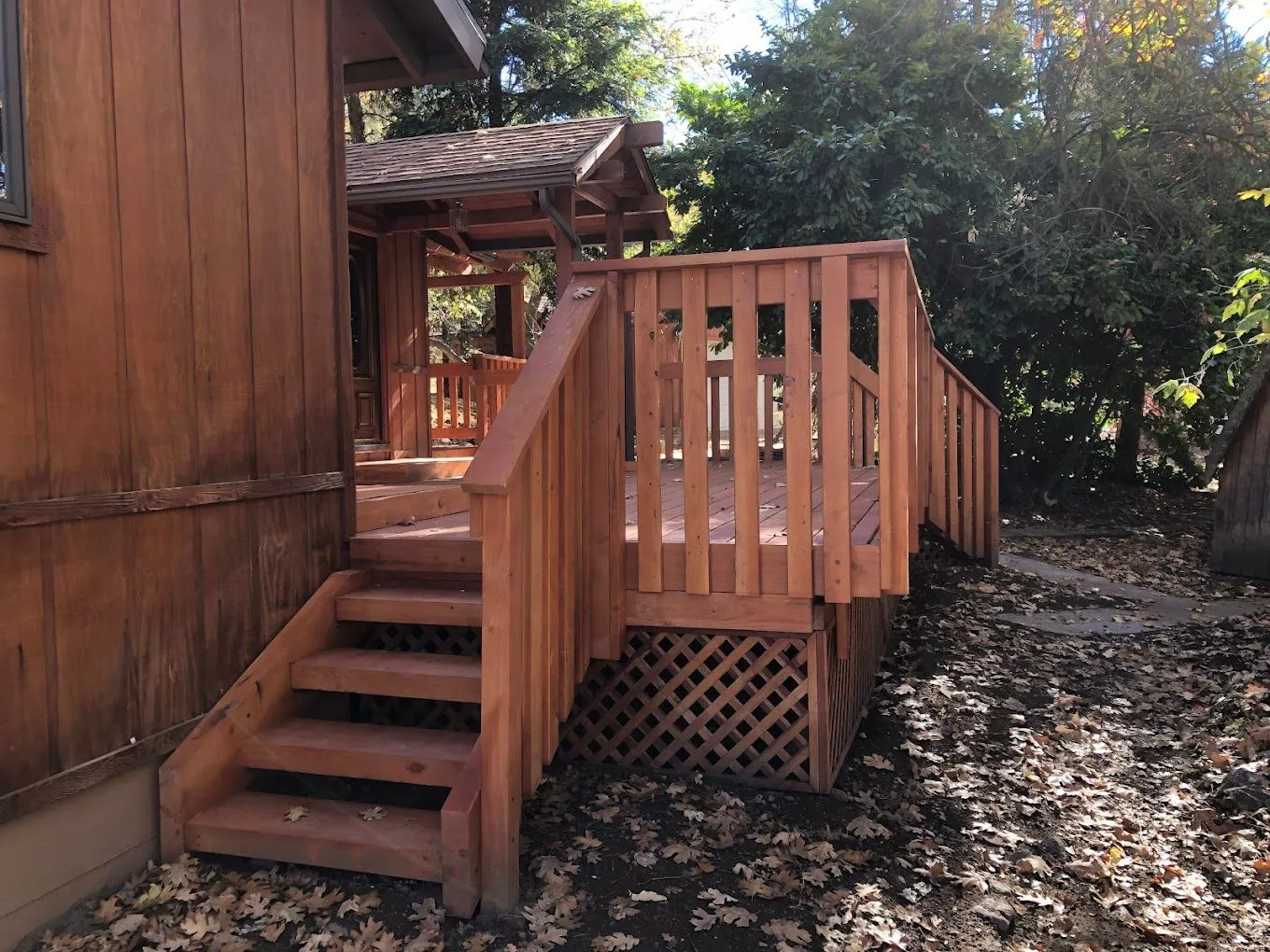
In Menifee’s inland heat, wood costs less up front but needs sealing every couple of years to fight the sun, while composite costs more at the start and is nearly maintenance-free for decades. The catch most people miss: dark composite gets uncomfortably hot underfoot in full Menifee sun, so the smart move is often a lighter composite board, or wood under a shade cover. Both need footings set for new-tract graded fill.
Wood or composite is the first question almost every Menifee homeowner asks me about a new deck, and the honest answer is that both are good, but the Menifee Valley climate pushes the decision harder than it would on the coast. We get long, dry, brutally sunny summers here, and that sun is the single biggest factor in how a deck looks and feels five and ten years out. After 35 years building wood exterior structures across the Inland Empire, here is how I walk Menifee clients through the choice.
Wood: lower cost, real upkeep in this sun
Premium wood, redwood or cedar or quality pressure-treated, costs less up front and looks beautiful the day it goes down. The trade-off in Menifee is maintenance. Our UV is relentless, and untreated or neglected wood grays, checks, and splinters faster here than in a milder climate. To keep a wood deck looking right in Menifee, you are sealing or staining it roughly every two years. Plenty of homeowners are happy to do that, and they get a warm, natural deck for less money. The key is going in with your eyes open about the upkeep, not finding out after the first summer.
Composite: higher cost, almost no maintenance
Composite decking costs more at the start, often noticeably more, but it shrugs off the Menifee sun with almost no upkeep. No sealing, no staining, no splinters. For a busy household that wants the backyard finished and forgotten, composite is the lower-stress choice over a ten or fifteen year horizon. When I run the real ten-year cost with clients, factoring in the sealant, the labor, and the weekends, composite often closes much of the gap that looked huge on day one.
The Menifee detail nobody mentions: heat underfoot
Here is the thing the brochures skip. In full Menifee sun, a dark composite board can get hot enough to be uncomfortable on bare feet by midafternoon, hotter than wood in the same spot. If your deck sits in open sun with no cover, I steer clients toward a lighter composite color, which absorbs less heat, or toward wood under a patio cover or pergola so the surface stays shaded. This is exactly the kind of local judgment call that matters more than the wood-versus-composite debate itself, and it is why I want to stand in your actual backyard and see where the afternoon sun lands before I recommend a material.
Whatever you choose, the footings decide whether it lasts
The material is the fun decision. The footings are the one that determines whether your Menifee deck is still tight and level in ten years. Most new Menifee tracts sit on imported graded fill, which has to be read and footed correctly or the deck settles unevenly down the line. We set proper footings for that ground, flash the ledger so water never sits against the house, and use coated or hot-dipped hardware rated for the exposure. Cheap fasteners and a shallow ledger are why decks pull away from the house, regardless of whether the boards on top are wood or composite.
Wood species and composite lines are not all equal
If you go wood, the species changes the maintenance math. Redwood and cedar are naturally more rot and insect resistant and hold color a little better, but they still need resealing on the same rough two-year cycle in Menifee sun. Quality pressure-treated pine costs less and, when it is a premium grade and sealed on schedule, performs well here too. On the composite side, the cheapest lines are older uncapped boards that still fade and stain, while a modern capped composite with a hard polymer shell resists the UV, the stains, and the scratches far better and is what I steer clients toward if they are paying for composite at all. Paying a bit more for a capped board is usually worth it over a bottom-tier line that ages badly and undercuts the whole reason you chose composite.
Railings, stairs, and shade are part of the deck budget
A deck is rarely just a platform. Railings are required by code above a certain height and they are a real line item, especially if you want cable, metal, or glass instead of standard wood balusters. Stairs add framing and footings of their own. And in Menifee, shade is not optional if you actually want to use the deck in July, so a patio cover, pergola, or shade sail often belongs in the same conversation and the same budget. Planning those pieces together from the start gives a cleaner result than bolting a cover onto a finished deck a year later, and it lets us size the framing and footings for the cover load up front.
Height changes the deck too. A ground-level deck a step off the slab is a very different project from an elevated deck that needs taller posts, lateral bracing, and a guard railing all the way around, and a raised deck over a slope opens up usable space underneath that many Menifee homeowners want finished for storage or shade. Elevated and multi-level decks carry more engineering and more cost, but on a lot that steps down they are often the only way to get a level outdoor room, and getting the posts, bracing, and connections right is exactly where an experienced builder matters most.
What a Menifee deck costs
Most residential decks are priced by size, height, railing, and material, with composite landing toward the upper end of the range for a given size. Patio covers and pergolas, which I often pair with a deck to beat the heat, are a separate line, set by span and finish. The right number for your yard comes after I see the lot, the grade, and where the sun hits. Call (909) 227-4193 and I will walk it with you.
Common Questions
Is composite worth the extra cost for a Menifee deck?
For many households, yes, because the Menifee sun makes wood maintenance a real recurring chore. Composite skips the sealing and staining entirely. Over ten years the higher upfront cost narrows once you count the sealant and the labor.
Does composite decking get too hot in Menifee sun?
Dark composite can get uncomfortably hot underfoot in full Menifee sun. We recommend a lighter composite color for open-sun decks, or pairing wood with a patio cover so the surface stays shaded.
How often does a wood deck need sealing in Menifee?
Roughly every two years to stay ahead of the UV. Our inland sun grays and checks neglected wood faster than a milder climate, so keeping up with the sealant is what keeps a wood deck looking right.
Will my new Menifee deck settle on a graded tract lot?
Not if the footings are set for that ground. New tracts sit on imported fill that has to be footed correctly. We set proper footings for the graded soil and flash the ledger so the deck stays tight and level.
Do I need a permit for a deck in Menifee?
Most decks over 30 inches high, and any structure attached to the house, require a permit through the Riverside County Building Department, which handles Menifee. We pull the permit, build to code, and meet the inspector.
Is a capped composite worth more than a basic composite board?
Usually yes in Menifee. A modern capped composite has a hard polymer shell that resists our UV, staining, and scratching much better than an older uncapped or bottom-tier board that still fades and marks. If you are paying for composite specifically to avoid maintenance, the capped line protects that investment, whereas a cheap composite ages badly and undercuts the reason you chose it.
Ready to Build Your Menifee Deck?
Call Ben directly. Free on-site walkthrough, written quote within 48 hours.
(909) 227-4193 Request a Free Quote OnlineRead more on our Menifee Deck Construction page, see what else we build across Menifee, or tell us about your backyard.