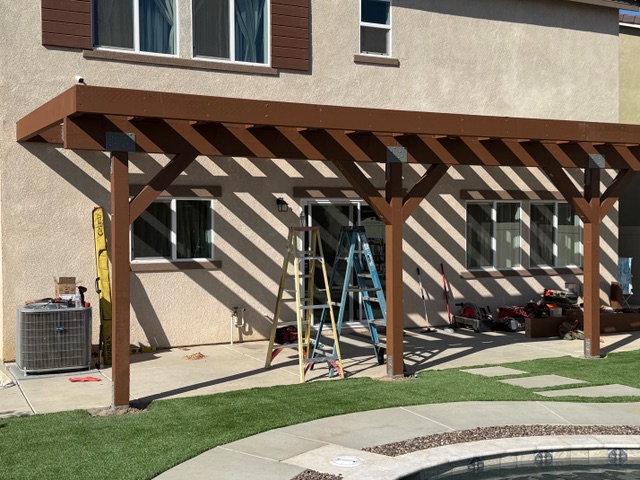
Residential pergolas in Riverside County usually attach to the house, use pressure-treated fir or cedar, and a full 16 by 14 foot scope with proper footings, hardware, permits, and finish is a low five-figure project. Commercial covers carry heavier load ratings, stamped drawings, and a longer plan check. The right configuration comes down to how the space will actually be used.
A wood pergola cover transforms a raw backyard slab into an outdoor room. In Riverside County, where summer afternoons regularly push past 100°F and winter rains arrive in concentrated bursts, the cover you choose has to do more than look good in the listing photo. It has to survive the sun, shed water, and stay structurally sound long after the contractor’s truck has left the driveway.
At BPP Construction we have been building wood pergola covers across the Inland Empire since 1990. This guide walks through what separates a residential pergola from a commercial installation, where the money actually goes, and how to decide which configuration fits your property.
Residential wood pergola covers: designed for family use
A residential pergola is almost always attached to the house, typically off a kitchen slider or a master-bedroom French door. The rafters are sized for a single span between the ledger board on the house and a pair of posts at the outer edge. Most Riverside homes we work on land in the 12 by 14 foot to 16 by 20 foot range, which is comfortable for a six-seat table plus a couple of lounge chairs without forcing the posts to carry structural loads they were not designed for.
The two most common wood choices for residential pergolas in Southern California are pressure-treated Douglas fir and western red cedar. Pressure-treated fir costs roughly a third less per linear foot, paints well, and handles the dry Inland Empire heat without excessive checking. Cedar is lighter, naturally rot-resistant, and finishes beautifully with a clear oil, but it costs more and shows every dent. For a family-use pergola that will see kids, dogs, and the occasional dropped tool, pressure-treated fir with a quality opaque stain is usually the better long-term investment.
Residential pergolas rarely need engineered drawings, which keeps permitting costs down. A standard patio-cover permit in Riverside County is a modest line depending on the jurisdiction, and most inspectors are familiar enough with typical residential spans that plan review moves quickly. The City of Riverside, Moreno Valley, Corona, and Beaumont each have their own nuances; we handle the submittal and inspection coordination on every job so homeowners never have to learn the difference between a Type V framing inspection and a final sign-off.
Commercial wood pergola covers: structural requirements change everything
Commercial pergolas live in a different code universe. Restaurants with outdoor dining, hotels with pool-deck shade structures, and retail centers with customer-gathering areas all trigger commercial-occupancy requirements the moment the pergola becomes a designated seating or traffic area.
What changes first is the loading. Residential patio covers are typically designed to a 10 pound per square foot live load, which is enough for California’s minimal snow scenarios. Commercial covers in public-access zones often need to be designed to 20 psf or higher, which drives up the required lumber size, post spacing, and hardware ratings. A 16 foot span that works fine with 4×10 rafters on 24 inch centers at a residence may need 4×12 rafters at 16 inch centers with engineered steel hold-downs at the post bases for commercial use.
The second shift is the approval path. Commercial work in Riverside and San Bernardino counties almost always requires stamped structural drawings, a separate electrical permit if lighting or fans are planned, and often an ADA review if the covered area is part of a required accessible route. Plan check can stretch six to ten weeks in the busier jurisdictions. We build the timeline into the quote upfront so there are no surprises when the health inspector asks why the outdoor dining area is not yet open on opening week.
Material-wise, we push commercial clients toward pressure-treated Douglas fir rated for ground contact, with stainless or galvanized hardware throughout. The upfront premium over residential-grade hardware is small but the service life nearly doubles. A commercial pergola on a coastal-influence property that fails in seven years is an expensive mistake; one that lasts twenty is a line-item the accountant forgets about.
Where the budget actually goes
Homeowners who price three contractors often find widely different numbers for projects that look similar on paper. The spread usually has more to do with what is included than with markup.
A typical residential 16 by 14 foot attached pergola in Riverside County should include: engineered connection to the house (ledger board flashed into the wall, not surface-mounted), 6×6 pressure-treated posts set in 18 inch concrete footings at a minimum 24 inch depth, 4×10 rafters with 2×6 top slats or a solid deck, hurricane ties or Simpson post bases on every bearing point, all required permits, one coat of primer plus two coats of exterior opaque stain, and cleanup. That full scope is a low five-figure project at current lumber prices.
Bids much below that number are usually skipping one of three things: the footings are shallower than code requires, the hardware is visible fasteners rather than concealed structural connectors, or the finish is a single coat of stain that will need redoing in eighteen months. We walk homeowners through line-item comparisons on any competing bid they bring us, because a cheap pergola that needs major remediation work in year three is not a bargain.
Matching the pergola to the rest of the home
The structural side of a pergola is eighty percent of the budget and ten percent of what homeowners talk about at the dinner table. The other ninety percent of the conversation is how it looks.
A few details make the difference between a pergola that reads as part of the house and one that looks stapled on. Match the rafter tail shape to any existing eave detail on the house: a chamfered cut, a plumb cut, or a rounded Craftsman tail should repeat whatever the original builder used. If the house has stucco, the post bases should land on a stucco-finished pedestal rather than a bare concrete footing. If the home is a mid-century ranch, a clean plumb-cut rafter and a flat 2×2 top slat reads better than a decorative scroll-cut.
Color matters too. In Riverside County we have had the best long-term results with semi-transparent deep walnut or solid dark-bronze stains. Clear finishes look gorgeous for six months and then UV-fade to a muddy grey. The deeper pigments hold their color through at least five summers before they need a refresh.
Common Questions
Do I need a permit for a pergola in Riverside County?
Yes, for nearly every attached cover and most freestanding ones. A standard residential patio-cover permit is a modest line depending on the jurisdiction. We handle the submittal and inspection coordination on every job.
What wood holds up best for a pergola here?
Pressure-treated Douglas fir with a quality opaque stain is the better long-term pick for family use. Cedar is lighter and finishes beautifully with a clear oil, but it costs more and shows every dent.
What does a residential pergola cover cost?
A typical 16 by 14 foot attached pergola with engineered house connection, 6×6 posts in real footings, structural hardware, permits, and a two-coat finish is a low five-figure project at current lumber prices.
What makes a commercial pergola different?
Public-access covers are designed to higher live loads, which drives bigger lumber, tighter rafter spacing, and engineered steel hold-downs. They almost always need stamped drawings, and plan check can stretch six to ten weeks.
Why do bids on the same pergola vary so much?
Low bids usually skip one of three things: code-depth footings, concealed structural connectors, or a real two-coat finish. We walk homeowners through line-item comparisons on any competing bid.
Planning a Pergola Cover?
A twenty-minute site walk answers more than an hour on the phone. Free written quote on every project.
(909) 227-4193 Request a Free Quote OnlineSee our project gallery, learn more about Ben and the crew, or read about our wood pergola work or wood patio covers.