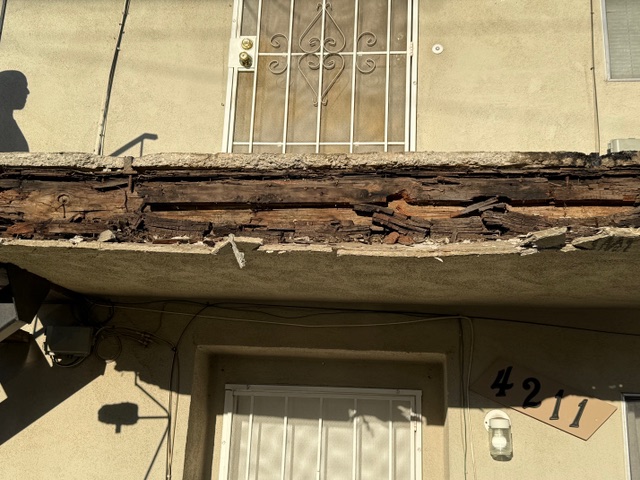
Five warning signs: peeling paint at joints, dark staining, soft spots under thumb pressure, opened joints, and rusting nail heads. Riverside County’s dry-summer, deluge-winter pattern makes rot move fast once it starts. Caught early it is a small repair. Ignored for six years it becomes a major reconstruction costing many times more.
Wood exterior repair is the single most-ignored maintenance category on Riverside County homes. Roof issues get attention because they leak. Plumbing issues get attention because they flood. Wood rot at the eaves, trim, and siding gets ignored for years because the damage is slow, cosmetic-looking from the street, and never causes an obvious immediate problem. Then the insurance inspector shows up and fails the house, or the wall sheathing behind the rot turns out to be structurally compromised, and suddenly a small repair that was deferred for six years has turned into a costly emergency many times larger.
BPP Construction has been doing wood exterior repair across the Inland Empire since 1990. This guide covers the warning signs every homeowner should watch for, what the repair process actually looks like, and how to know when a patch is fine and when a larger reconstruction is required.
The warning signs that mean it is time to call
Most wood exterior problems announce themselves years before they become serious. Knowing what to look for during a ten-minute annual walk-around can save thousands over the life of a house.
Peeling or flaking paint, especially at joints and edges. Paint fails when the substrate underneath is moving, and wood moves when it is absorbing and releasing moisture. Paint failure at a specific location almost always indicates water intrusion at that location. A spot of failing paint at a corner trim joint is the first visible symptom of rot starting inside the joint. Addressing it when the paint first fails is a one-hour touch-up; waiting until the wood is visibly dark or soft requires replacement.
Dark staining on wood surfaces. Healthy wood weathers to a silver-grey when unfinished or stays paint-stable when painted. Dark streaks, black patches, or brown staining in specific areas indicate prolonged wet conditions, which is the starting point for rot. Common locations: directly below gutter seams that leak, at the base of vertical trim pieces that meet horizontal surfaces, around window sills and door heads, and at any penetration through the exterior (vent stacks, electrical conduit, hose bibs).
Soft spots when you press on the wood. A healthy wood member resists thumb pressure. A rotting member gives, sometimes dramatically. Check eave fascia, trim boards, and any exposed structural wood at least annually by firm thumb pressure. Any softness means the wood has already lost significant structural capacity.
Visible gaps at joints or separation between boards. Joints that were tight at installation and are now open have either moved (suggesting structural movement in the wall behind them) or contracted due to wood drying out and cracking. Both conditions create water intrusion paths and accelerate the next stage of damage.
Rust staining on or around nail heads. Rust staining indicates that the fastener is exposed to moisture, often because the caulking or paint sealing the fastener has failed. Rust itself is mostly cosmetic, but the condition causing the rust is usually the problem that needs addressing.
Why wood exterior damage happens in Riverside County specifically
Our climate is harder on exterior wood than most homeowners assume. The Riverside County pattern of dry, intense summers followed by concentrated winter rain creates freeze-thaw-like stress on wood even without actual freezing temperatures.
In summer, wood dries out rapidly. Moisture content in exterior wood can drop to single digits during extended heat waves. The wood shrinks, joints open, paint surfaces crack, and fastener heads pop slightly proud as the wood around them moves.
When the first winter rain arrives in October or November, water enters those opened joints and cracked paint surfaces. Inland Empire winter rain is often delivered in concentrated bursts, two or three inches in 24 hours is not unusual, which overwhelms the minor water management systems the house was designed with. Water gets behind flashing, behind siding, into trim joints, and stays there.
The wood swells. The paint surface, which was cracked to begin with, lifts further. The next dry cycle pulls the wood apart again, now with water damage already started. Repeated over five to seven winters, this cycle produces visible rot.
Properties closer to the coastal-influence zone (western Riverside County, Norco, Corona) experience a milder version of this cycle with additional salt-air influence. Desert-side properties (Hemet, Beaumont, Banning) experience more extreme dry-to-wet transitions and faster wood degradation.
The repair process: from assessment to finished work
A typical wood exterior repair project moves through four phases.
Assessment and scoping. We start with a full exterior walk-around, documenting every area of concern with photos. Some spots that look bad from ten feet away turn out to be purely cosmetic once probed; some spots that look minor turn out to extend several feet into the adjacent wall when the trim is pulled. The written scope covers not just the visible damage but also the adjacent areas that need to be investigated during the demolition phase.
Demolition and investigation. Rotted trim and siding comes off. We inspect the wall sheathing, weather barrier, and framing behind the damage. This is frequently where scope expands: rot that looked contained to one fascia board reveals sheathing rot behind it, or weather-barrier failure on an entire corner of the house. We stop, re-assess, update the homeowner, and adjust the scope before proceeding. Surprises are built into the pricing as a contingency on every project; change orders come from scope expansion, not from discovered conditions alone.
Repair and rebuild. Damaged sheathing is replaced with current-spec material (typically 7/16 inch OSB or 5/8 inch plywood depending on the application). Weather barrier goes back on properly, with correct laps and flashing integration. New trim, siding, or framing members are installed using pressure-treated or decay-resistant material wherever the replacement is in a moisture-exposed location. Every joint and fastener gets sealed.
Finishing. The repair gets primed and painted to match the existing house. Color matching on painted exteriors is usually straightforward; color matching on natural-wood-stained surfaces is more challenging because new wood accepts stain differently than aged wood. We manage expectations on this upfront and sometimes recommend finishing a larger area than strictly necessary to blend the transition.
When a spot repair is enough and when it is not
Not every wood exterior problem needs a major project. A significant percentage of what we look at can be resolved with a focused repair and routine maintenance going forward. The trick is knowing which situation you are actually in.
A spot repair is usually enough when: the damage is contained to a specific area, the cause of the damage has been identified and can be addressed (clogged gutter, failed caulk joint, flashing problem), the surrounding wood tests as sound, and the paint or finish system on the rest of the exterior is in reasonable condition.
A larger reconstruction is usually required when: multiple areas of the house show similar damage (indicating a systemic issue rather than an isolated failure), the wall sheathing behind the trim or siding has deteriorated, the house has extensive paint failure across multiple elevations, or the house is approaching the end of its expected paint service life (typically 8 to 12 years for a quality paint job in our climate).
Homeowners sometimes try to split the difference with a spot repair followed by a patched paint job across the whole house. This rarely works long-term. The underlying causes of the damage are often still present on the unrepaired areas, and the mismatched repair areas become visible within a year or two as the new and old surfaces weather differently.
Ongoing maintenance to prevent repeat damage
Once wood exterior damage has been repaired, three maintenance practices keep it from coming back.
Gutter maintenance on a twice-yearly schedule. Clogged gutters are the single most common contributing factor to wood exterior damage. A gutter cleaning in fall before the first rain and another in spring after the worst of the Santa Ana wind season is inexpensive and prevents thousands in eventual wood repair.
Caulk joint inspection annually. The caulking around windows, doors, and trim joints has a service life of seven to ten years in our climate. A walk-around every spring identifying failed caulk joints and reapplying where needed is a few hours of work that extends the life of the exterior dramatically.
Paint refresh on a realistic schedule. A quality paint job in Riverside County lasts eight to twelve years on sun-exposed elevations and ten to fifteen on shaded elevations. Planning a full exterior repaint at the lower end of those ranges, rather than waiting for visible failure, keeps the wood surfaces continuously protected.
Common Questions
How do I check my own house for wood rot?
A ten-minute annual walk: thumb-press the fascia and trim, look for paint failure at joints, and check for dark streaks below gutter seams and around penetrations. Any softness means real capacity is already lost.
Can rotted wood be patched, or does it need replacement?
Localized surface rot at a joint can often be repaired in place. Softness across the width of a member means replacement; by that point the wood has lost its structure.
What does wood exterior repair cost?
Typical eave, fascia, and trim repair packages are priced by extent. The expensive jobs are the ones that waited until sheathing or framing behind the trim was involved.
Why does this matter for my insurance?
Exterior wood rot is the single most-flagged item on Riverside County home insurance inspections, and carriers attach repair deadlines to it.
Does paint actually prevent rot?
A maintained finish is the primary defense. Paint failing at a specific spot is the first visible symptom of water getting in at that spot, and a one-hour touch-up then beats board replacement later.
Worried About Rot?
We will tell you straight whether you are looking at a small repair or a larger project, before you commit to anything.
(909) 227-4193 Request a Free Quote OnlineSee our project gallery, learn more about Ben and the crew, or read about our wood exterior repair work and exterior painting.