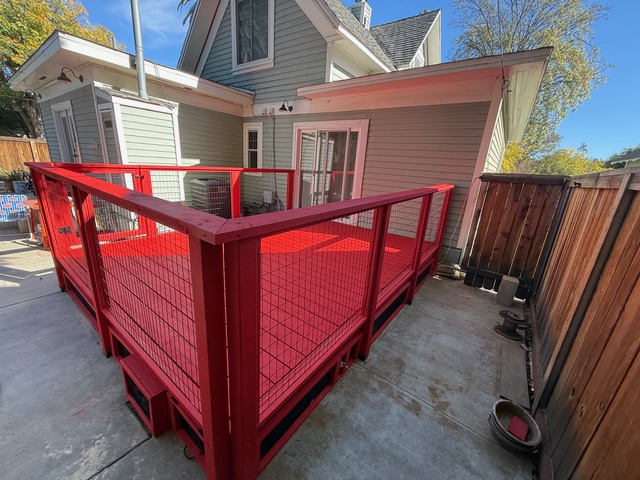
In the open neighborhoods east of the 215, wind is the load a deck has to answer for, and the board on top has very little to do with it. The connectors, the post bases, and the way the ledger meets the house carry that work. Footings need to suit the soil on your lot, which can be sandy on one street and clay on the next. And anything vertical you add, from a privacy screen to a solid cover, changes the wind math.
People shopping for a deck tend to spend their attention on the boards: the color, the grain, wood or composite. Ben spends his on the parts you never see once the deck is finished. In Perris that order of priorities is not a quirk. The valley funnels air down toward the lake, and the open tract yards east of the 215 catch gusts that a sheltered lot in an older city never gets. A deck here has to be held together in a way that keeps it together when that air arrives sideways.
Where the Wind Actually Grabs a Deck
A low, open platform does not present much to the wind on its own. Air moves over it and under it. The trouble starts with everything that stands up from it.
Railings are the first thing. A row of balusters is a surface, and on a raised deck that surface sits high, where gusts are stronger and work on a longer lever against the posts holding it. A solid privacy screen along one side is a much larger surface. A roof over the deck is the largest of all, and it does not only push sideways. Wind moving across and under a solid cover tries to lift it.
Skirting closes the gap under a raised deck and keeps air from passing through, which can also add load. Even outdoor furniture and a shade sail tied to a railing post put force into places that were not designed for it.
So the first conversation on a Perris deck is about what will be on it and around it, and only then about how big the floor is. A plain platform and a deck with a cover and a privacy wall are different structures, and they get framed and fastened differently from the footing up.
Connectors, Post Bases and the Ledger
Older decks were often built with nails driven at an angle through one board into another. That is called toenailing, and it holds fine under the weight of people standing on a deck. It does a poor job against a force pulling the pieces apart, which is exactly what wind uplift does.
The answer is rated metal connectors. Joist hangers where joists meet a beam or ledger. Ties at beam to post connections. Rafter ties on any cover. Each connector is made to carry load in a specific direction, and each one has to be installed with the fasteners it was designed for, which is a detail that often gets skipped when a crew is in a hurry.
Post bases do two jobs. They anchor the bottom of each post to its concrete footing so the post cannot walk or lift, and they hold the end grain up off the concrete so it is not sitting in water after a storm.
Where the deck attaches to the house, the ledger has to be bolted into the framing behind the stucco and flashed so water sheds out instead of in. A ledger that only grabs stucco is decoration. Our Perris deck construction page lays out how we build that connection.
Sand on One Lot, Clay on the Next
The Perris Valley floor does not have one kind of soil. Some areas are sandy and some are heavy with clay, and the change can show up between lots that look identical from the street. Footings have to be sized for what is actually in the ground, so Ben checks the site during the free visit before anything gets quoted.
Sandy ground digs easily and gives up its grip easily. The sides of a hole can slough in while it is being dug, and loose sand does not hold a footing as firmly against uplift or a sideways shove. Sandy areas may need deeper or wider footings than clay heavy ones to do the same job.
Clay holds a clean hole and bears weight well, and then it brings its own problem. Clay swells when it gets wet and shrinks as it dries, and that movement works on anything set into it. Keeping water away from the footings matters on clay ground: gutters and downspouts that discharge away from the deck, a grade that slopes away from the posts, and the top of each footing crowned so water runs off the concrete.
Your neighbor’s deck is not a soil test for yours. What worked two lots over can be sitting on different ground.
Ground-Level Platform or Raised Deck on a Big Lot
Perris lots tend to run larger than most, which opens up a choice many owners do not realize they have. With room to spread out, a deck does not need to be raised to make space. A ground-level platform can cover a big footprint and sit low enough that it barely registers to the wind.
A low platform still asks for some things. The framing sits close to the dirt, so it needs lumber rated for ground contact and enough clearance for air to move under it. The grade under it needs to drain, or water collects under the boards and stays. And it needs a plan for weeds, which will find any gap.
A raised deck makes sense where the yard falls away from the house or where the owner wants to step out of a sliding door at floor level. It needs railings, bracing between posts, and more attention to every connection above, because height lengthens the lever on everything the wind touches. Whether a permit is required depends on factors like height and how the deck attaches, and we check that against your address before drawing.
If the deck sits near a property line, it is worth planning the fence at the same time. Our Perris fence construction page covers that work.
Shade That Stays Put
From May through October, a Perris deck without shade gets used early in the morning and after dark. Most owners want a cover at some point, and the wind question follows the shade question straight up.
A solid roof gives full shade and catches the most wind. It needs footings sized for its load, posts tied to those footings with rated bases, and rafters tied down against lift. Planning the cover with the deck means the posts can land on footings poured for that job, instead of reinforcing framing that is already in the ground.
A lattice or open rafter cover filters the light and lets a good share of the wind pass through. It throws a moving shadow instead of a solid one, and it keeps daylight in the windows behind it. Ben walks owners through that tradeoff during the visit, standing in the yard in the afternoon if possible, because the right answer depends on which way the deck faces and how exposed that side of the house is.
Board color is the last piece. A lighter board stays cooler underfoot in full sun than a dark one, wood or composite.
What Perris Owners Ask About Decks and Wind
Are nails enough to hold a deck together?
Nails driven at an angle hold a deck down under the weight of people. They are weak against wind trying to pull pieces apart. Rated metal connectors at joists, beams, posts, and rafters, installed with the fasteners they were made for, are what keep a deck in one piece when gusts move through an open yard.
Is a low deck less of a wind problem?
Generally, yes. A ground-level platform presents very little surface for the wind to push on, and it has no high railings acting as a lever. The wind load climbs once you add height, railings, privacy screens, or a solid cover. That is why a big Perris lot can be a good place to build low and wide.
Does my soil change how deep the footings go?
It can. The Perris Valley floor runs from sandy to clay heavy, sometimes lot to lot. Sandy ground may need deeper or wider footings to hold against uplift, and clay needs water kept away so it does not swell around the concrete. Ben looks at the ground during the free visit before he quotes anything.
Stand in the Yard With Ben on a Windy Day
He checks the exposure, the soil, and the wall the deck would meet, then puts the platform and any cover into one free quote. Thirty-five years of building in the Inland Empire. See how we approach deck work in this city.
(909) 227-4193 Talk to BenFinished decks and covers are in the project gallery, the details live on our Perris deck construction page, and you can send us your yard dimensions or call (909) 227-4193.